
Healthcare direct mail for providers, practices, and health systems.
Healthcare direct mail runs at the high end of every benchmark — open rates, response rates, lifetime patient value per acquired piece. The structural reason is trust: the patient opens the envelope from their provider, registers the offer or reminder, and acts on it at multiples of the rate they apply to digital channels they have learned to ignore. DirectMail.io brings the platform to healthcare with secure patient-data handling, EHR integration (Epic, Cerner, Athenahealth, eClinicalWorks), per-patient variable data, and SOC 2 Type II certified infrastructure. Programs that historically required separate clinical, marketing, and operations reviews run as integrated campaigns inside one platform.
Why direct mail outperforms digital in healthcare.
- 01
Secure patient-data handling from intake
Patient lists are sensitive from the moment they land. The platform ingests under PGP encryption, scopes access per program, and keeps suppression rules in force on every send — on SOC 2 Type II certified infrastructure. The security posture is structural, not an after-the-fact review.
- 02
Recipient trust is the channel
Patients open mail from healthcare providers at materially higher rates than from any other vertical. The trust is structural — physical mail from a known provider isn't spam, isn't phishing, and gets opened. The lift on response is what makes recurring direct mail programs sustainable in healthcare where digital channel fatigue is highest.
- 03
Recurring programs match the care cadence
Annual physical reminders, vaccination prompts, screening recall, post-visit follow-up — all natural fits for recurring direct mail tied to events on the patient list. The campaign cadence aligns with clinical cadence; the programs run themselves.
- 04
Variable data drives clinical relevance
A "you're due for a colonoscopy" reminder works because it's addressed to the patient who is actually due, not to an undifferentiated mass list. Variable data per record turns the generic mailing into a clinically-relevant prompt — and response rates reflect the difference.
- 05
Local geography matches the practice footprint
Healthcare is local. The patient drives to the clinic; the recipient lives in the practice's service territory. Drop-ship to local DDU entry and the pieces deliver fast within a tight geography — faster reads, faster appointments, faster revenue.
Six recurring healthcare programs.
The programs below are the ones that consistently move the needle for healthcare providers running on DirectMail.io. Implementation specifics for each — including secure patient-data handling — get covered in the demo.
- 01
Annual screening recall
Mammography, colonoscopy, and other interval screenings. Variable data fires per patient on the actual recall date — not a generic monthly drop. Highest-volume recurring program in primary care and specialty practice.
- 02
New patient acquisition
New-mover families in the practice service area get an introductory mailing within 60 days of move. Pediatric, primary care, and dental practices use this consistently.
- 03
Appointment reminders
Pre-visit reminder mail with prep instructions, location, parking — variable per appointment. Reduces no-shows materially when paired with email and SMS reminders on the same recipient.
- 04
Reactivation programs
Patients who haven't scheduled in 12+ months get a reactivation piece tied to their last visit type. The retained patient is meaningfully more profitable than the new acquired patient.
- 05
Specialty practice referral
Cardiology, orthopedics, dermatology and other specialties mail to demographic-and-condition-targeted households for specific service lines.
- 06
Post-discharge follow-up
Hospital systems mail post-discharge instructions, follow-up appointment prompts, and care-plan summaries — both for compliance and for outcomes (reduced readmission rates).
Patient-grade creative. Provider-grade reporting.
Sample pieces and a live attribution view. Final creative thumbnails drop in here once your program is scoped.
-
 Sample
 Annual screening recall — variable-data, fires on the patient’s actual recall date.
- Sample
Appointment reminder with prep + location, personalized per visit.
- Sample
New-patient acquisition for in-territory new-mover households.
 Sample
 Why DirectMail.io is built for healthcare.
Most practices run mail through a stitched stack — a designer, a list vendor, a printer, a separate reminder tool. DirectMail.io collapses that into one platform. Connect the EHR once, and screening recall, appointment reminders, and reactivation fire automatically on patient-list data. Your team runs clinical operations, not mail logistics.
The campaigns are more powerful because every piece is personalized per patient — the right screening, on the right recall date, to the right household — and reinforced on that same patient by email and SMS (with consent) from the same list. One audience, every channel, one place.
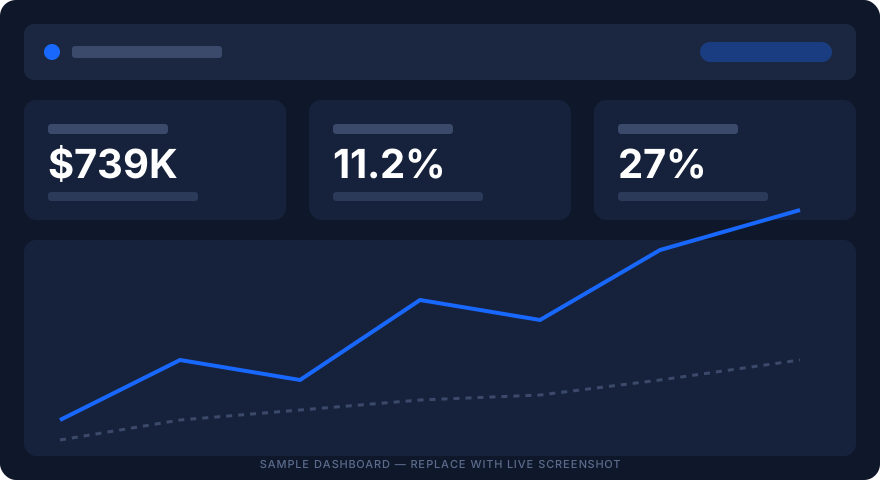
And you can prove it. Informed Delivery, response, scheduled appointments, and no-show reduction update live on the dashboard, with the audit documentation produced automatically as a byproduct of every send. Performance you can see; compliance you can defend.
Get a plan for your patient list.
Tell us where to send it. We’ll come back with a screening-recall and reminder plan, sample creative, and the attribution model — built on SOC 2 Type II certified infrastructure with secure, encrypted data handling.
- Built on SOC 2 Type II infrastructure
- Sample creative + dashboard mockup included
- No commitment — a plan you can take anywhere
Questions teams ask first.
Short answers. For data-security questions, EHR integration scoping, or implementation specifics, book a demo.
-
How does DirectMail.io secure patient data?
Patient lists ingest over PGP-encrypted SFTP, with per-account scoped access controls, audit logging on every operation, and per-record consent tracking with right-to-delete propagation — all on SOC 2 Type II certified infrastructure. Specifics on data flow and the security controls in place are covered in the implementation discussion at demo.
-
What healthcare data sources integrate with DirectMail.io?
EHR systems (Epic, Cerner, Athenahealth, eClinicalWorks, NextGen and others) integrate via SFTP or API for patient list export, appointment data, and recall triggers. Practice management systems (DrChrono, Kareo, AdvancedMD) integrate similarly. The integration handles scheduled exports, encrypted transfers, and field mapping into the variable-data layer for personalized campaign output. Custom integrations for in-house systems configure through the platform API.
-
How does the platform handle patient consent and opt-out preferences?
Per-record consent and communication preferences flow with the patient list and propagate through every send. Patients who opted out of marketing communications never receive marketing mail; patients who opted out of specific channels receive the others. Right-to-delete requests propagate to active campaigns and to the underlying recipient list. Suppression files maintain at the practice or system level for healthcare-specific exclusions (deceased patients, transferred patients, opt-out lists).
-
What kind of response rate should a healthcare practice expect?
Healthcare consistently runs at the high end of direct mail benchmarks. Annual screening recall typically lands in the 8-15% response range when targeted accurately and timed to the actual recall date. New patient acquisition mailings to in-territory new-movers run 2-5%. Appointment reminders reduce no-show rates by meaningful percentages — the math depends on the practice's baseline no-show rate, but the impact on schedule density is consistently large. Specifics by program live in the healthcare implementation discussion.
-
How do hospital systems and large multi-location practices use the platform?
Multi-location healthcare runs on the platform with corporate-level brand templates and location-level customization. Each clinic, urgent care, or specialty practice runs campaigns within the rails corporate sets — local provider name, location, contact, service-line variation — without compromising brand consistency or compliance posture. Reporting rolls up to the system level for executive review and drills down per-location for clinical operations.
-
Can DirectMail.io coordinate direct mail with email and SMS for healthcare recipients?
Yes — with consent. Patients who opted in to email or SMS receive coordinated touches across all consented channels. The mail piece is the anchor; email and SMS reinforce on the same patient with the same message. For sensitive communications, clinical detail stays out of unsecured channels — the content uses general references and CTAs that route to secure portals.
Run the healthcare playbook on your patient list.
Bring an EHR export sample. We’ll show the screening recall, appointment reminder, and new-patient acquisition campaigns running on it under PGP-encrypted ingest — in 30 minutes.